

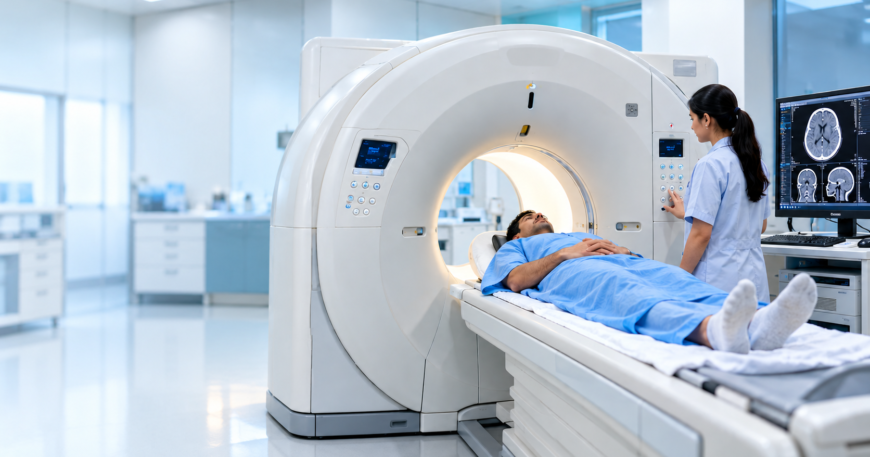
Looking for a reliable CT Scan in Greater Noida? Fusion Diagnostics helps patients enquire about diagnostic imaging services, appointment availability, and preparation requirements. A CT scan uses X-rays and computer processing to produce detailed images of internal body structures, helping doctors investigate injuries and certain medical conditions. Before booking, it is important to understand why your doctor has recommended the examination, whether preparation is required, and what to expect during the procedure. This guide answers common patient questions and explains how to prepare for your appointment.
What Is a CT Scan and Why Is It Recommended?
Computed Tomography (CT) is a diagnostic imaging technique that produces cross-sectional images of the body. It helps doctors examine internal organs, bones, blood vessels, and soft tissues in greater detail than a conventional X-ray can provide.
A doctor may recommend CT imaging to investigate symptoms, assess an injury, identify certain abnormalities, or monitor a known condition. The appropriate examination depends on your medical history and the clinical question that needs to be answered.
CT is not always the first or most appropriate imaging test. Depending on your symptoms, your doctor may recommend an X-ray, ultrasound, MRI, or another investigation instead.
When Might You Need a CT Scan?
CT imaging can support the investigation of several medical concerns:
- Head and brain: Assessment of selected head injuries, suspected bleeding, and other neurological concerns.
- Chest and lungs: Investigation of certain lung abnormalities and chest conditions.
- Abdomen and pelvis: Examination of internal organs and some causes of abdominal pain.
- Bones and joints: Evaluation of complex fractures and selected injuries.
- Blood vessels: CT angiography for examining blood vessels when clinically indicated.
- Follow-up examinations: Monitoring selected conditions or evaluating treatment response.
A CT scan does not automatically confirm a diagnosis. Your doctor interprets the report alongside your symptoms, physical examination, and other relevant findings.
CT Scan Preparation and Procedure at a Glance
| Patient question | What to expect |
|---|---|
| Why is a CT scan performed? | To obtain detailed images of internal body structures |
| Is preparation necessary? | Instructions depend on the examination |
| Do I need to fast? | Only if specifically instructed |
| Is contrast material required? | Some examinations need it; others do not |
| Is the procedure painful? | Generally painless |
| How long does it take? | The scan may take a few minutes; the total visit varies |
| Who reviews the images? | A radiologist interprets the images and prepares a report |
| Is radiation involved? | Yes, CT uses ionising radiation |
How to Prepare for a CT Scan
Preparation depends on the body area being examined and whether contrast material is needed. Follow the instructions supplied by your doctor and diagnostic centre.
1. Carry your prescription and previous reports. Bring your referral and relevant earlier imaging results to help the team understand the examination requested.
2. Inform the team about your medical history. Mention kidney disease, allergies, previous reactions to contrast material, thyroid conditions, and medicines you take.
3. Confirm fasting instructions. Not every CT examination requires fasting. Ask the centre for instructions specific to your scan.
4. Tell the team if you are pregnant or could be pregnant. Your doctor can assess the clinical need, potential risks, and appropriate alternatives.
5. Wear comfortable clothing. You may be asked to remove jewellery, metallic accessories, or other items that could interfere with imaging.
6. Ask whether contrast is required. Some examinations use contrast material given orally or through a vein. Your healthcare team will explain any additional precautions or tests that may be necessary.
Do not stop prescribed medication unless your healthcare professional advises you to do so.
CT Scan With Contrast vs Without Contrast
Contrast material can help make certain structures more visible, but it is not needed for every CT examination.
| Feature | CT with contrast | CT without contrast |
|---|---|---|
| Contrast agent | Administered when indicated | Not administered |
| Main purpose | Improves visibility of selected organs, tissues, or blood vessels | Provides images without a contrast agent |
| Preparation | May require additional instructions or safety checks | Depends on the examination |
| Choice of scan | Based on the clinical question | Based on the clinical question |
Your doctor determines which approach is appropriate. Inform the healthcare team about kidney problems or previous reactions to contrast material before your appointment.
What Happens During a CT Scan?
A CT scan is generally painless. The imaging team first confirms your details and the examination requested by your doctor. You will lie on a scanning table that moves through a large, ring-shaped scanner.
The machine captures images while you remain still. You may be asked to hold your breath briefly to improve image quality.
If contrast material is required, it may be administered orally or through an injection into a vein. A temporary warm sensation or metallic taste can occur after an injection. Inform the imaging staff if you experience unusual symptoms or feel unwell.
The scan itself often takes only a few minutes, although preparation and total appointment time vary. A radiologist interprets the images and prepares a report for your referring doctor, who explains the findings in the context of your health.
Is a CT Scan Safe?
CT scans use ionising radiation. Doctors recommend them when the expected diagnostic benefit outweighs the potential risks. Radiation exposure varies according to the examination and scanning protocol.
Contrast material can cause adverse reactions in some patients. People with kidney disease or a history of contrast reactions should inform their healthcare team before the procedure.
Pregnancy or possible pregnancy should also be discussed before scanning. Your doctor can assess the clinical need and whether an alternative imaging method may be appropriate.
For further information, read the NHS CT scan guide and RadiologyInfo’s CT preparation guide. These resources provide general medical information; follow the instructions given by your own healthcare team.
How to Choose a CT Scan Centre in Greater Noida
Choosing a diagnostic facility involves more than comparing distance and price. Before booking, consider these factors:
- Examination availability: Confirm that the centre performs the scan prescribed by your doctor.
- Qualified reporting: Ask how images are interpreted and how the report will reach your referring doctor.
- Preparation instructions: Make sure you understand fasting, contrast, and other examination-specific requirements.
- Transparent pricing: Confirm the total charge and whether contrast or additional services cost extra.
- Appointment convenience: Check timings, location, and expected reporting time.
Fusion Diagnostics has a centre listed in Gaur City 1, Sector 4, Greater Noida West. Contact the centre to confirm the availability of your specific examination, current charges, and appointment details before travelling.
Frequently Asked Questions About CT Scans
How long does a CT scan take?
The scan itself often takes a few minutes. Preparation, contrast administration, and the examination protocol can affect the total appointment time.
Do all CT scans require fasting?
No. Fasting requirements depend on the specific examination. Follow the instructions provided by your doctor or diagnostic centre.
Is a CT scan painful?
The scanning procedure is generally painless. Some patients may experience discomfort from remaining still or temporary sensations after contrast injection.
When will I receive my CT scan report?
Reporting times vary according to the examination and clinical requirements. Ask the centre about its expected turnaround time when booking.
What is the cost of a CT scan in Greater Noida?
The cost depends on the body area, type of examination, and whether contrast or a specialised protocol is required. Contact the centre for current pricing.
Can I resume normal activities after a CT scan?
Many patients can return to their usual activities shortly after the examination. Follow any specific instructions provided by your healthcare team.
Book Your CT Scan Appointment at Fusion Diagnostics
If your doctor has recommended a CT Scan Test in Greater Noida, contact Fusion Diagnostics to enquire about examination availability, preparation requirements, appointment timings, and current charges.
Centre address: NH3, GH1, Gaur City 1, Sector 4, Greater Noida West, Uttar Pradesh 201318.
Phone: +91 92 88 22 77 00
Opening hours: Monday–Saturday, 8:00 AM–8:00 PM; Sunday, 8:00 AM–2:00 PM.
Looking for a CT Scan Near Me in Greater Noida? Visit the Fusion Diagnostics CT Scan service page to learn more. Contact the centre before travelling to confirm that your prescribed examination is available.
Your doctor can help determine whether CT imaging is appropriate for your condition.
Medical disclaimer: This article is for educational purposes only and does not replace professional medical advice, diagnosis, or treatment.
Medical review: Before publication, have a qualified radiologist verify the medical information. With their permission, add their name, relevant qualifications, professional profile, and review date.
