
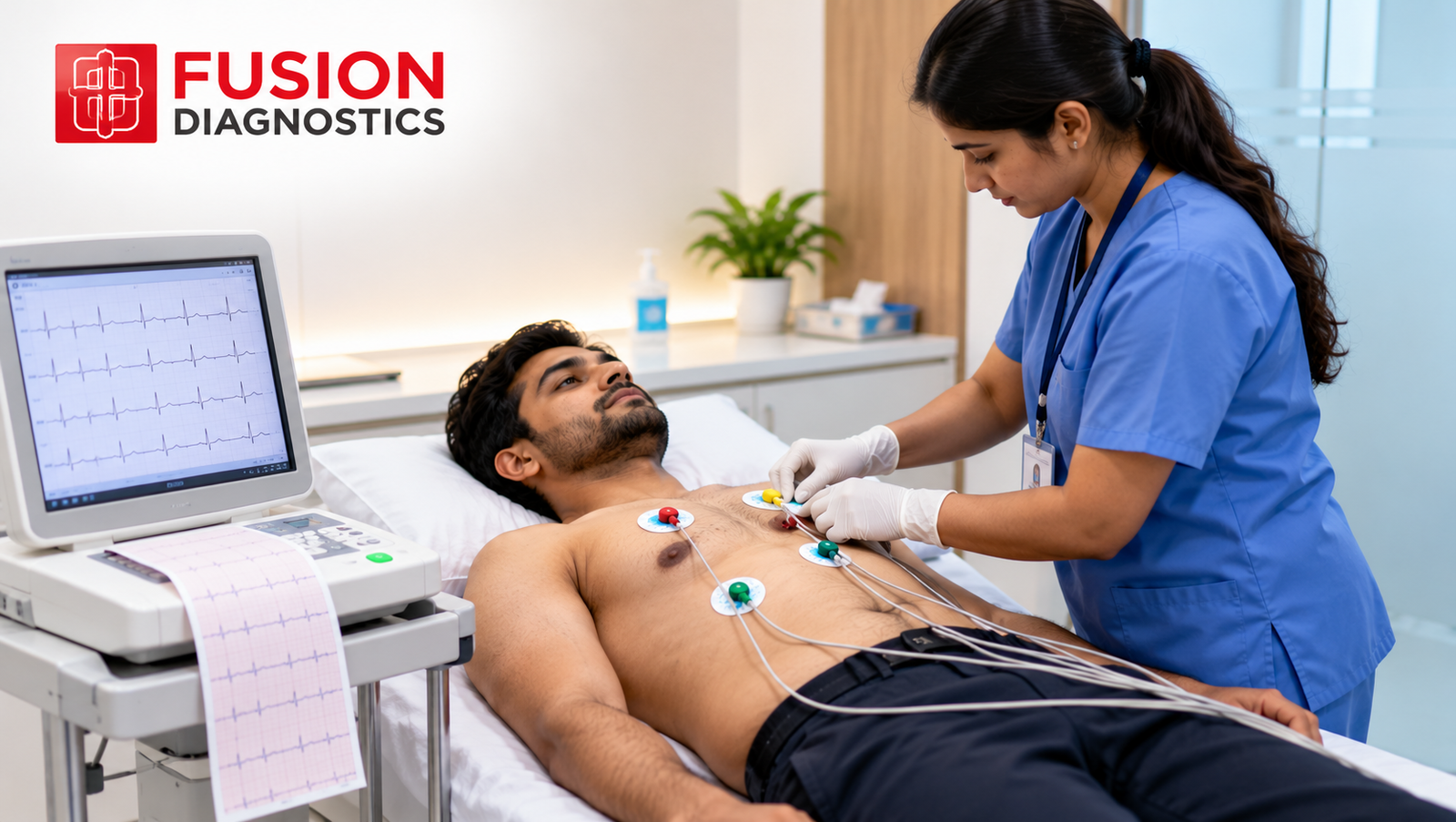
ECG in Noida

Looking for a ECG in Noida? Fusion Diagnostics provides diagnostic services for patients looking for ECG in Noida. Our centre is located at Spectrum Metro Mall, Sector 75, Noida, making it accessible for patients seeking an electrocardiogram as part of a medical evaluation or follow-up.

Contact Fusion Diagnostics to enquire about ECG availability, appointment scheduling and any instructions relevant to your visit.

ECG in Noida
ECG Test in Noida at Fusion Diagnostics

What is an ECG Test?

An electrocardiogram is a diagnostic test that records the electrical activity generated by your heart. The electrical signals coordinate the contraction of the heart muscle, allowing blood to circulate through the body.

During a standard resting ECG, small adhesive sensors called electrodes are placed on selected areas of the chest, arms and legs. These electrodes connect to a machine that records the signals and displays them as a series of waves on paper or a digital screen.

An ECG can provide information about:

  • Heart rate during the recording.
  • The regularity of the heartbeat.
  • Electrical conduction patterns.
  • Certain changes that may be associated with heart conditions.
  • Findings that may require further clinical investigation.

Doctors may recommend ECG in Noida when symptoms, medical history or examination findings suggest that recording the heart’s electrical activity would be useful.

An ECG does not send electricity into your body. It only detects and records electrical signals produced naturally by the heart. Although it is an important cardiac investigation, it cannot identify every heart condition on its own. Results must be interpreted in the context of the patient’s symptoms and medical history.

Why Might a Doctor Recommend an ECG Test?

An ECG may be recommended for several clinical reasons. Your doctor will decide whether the test is appropriate based on your symptoms, health history and the information needed for your assessment.

Common reasons include:

Palpitations

A racing, pounding or irregular heartbeat may prompt an ECG to check the heart's rhythm during the recording.

Chest discomfort

An ECG can help assess certain electrical changes associated with cardiac problems. New or severe chest pain requires urgent medical assessment rather than waiting for a routine appointment.

Dizziness or fainting

In some cases, an abnormal heart rhythm can contribute to dizziness or loss of consciousness. An ECG may form part of the evaluation.

Shortness of breath

When breathlessness may be related to a heart condition, a doctor may recommend an ECG alongside other assessments.

Known heart conditions

An ECG can help monitor electrical activity in patients with certain diagnosed cardiac conditions.

Medication monitoring

Some medicines can affect heart rate or electrical conduction. An ECG may be advised when clinically appropriate.

Pre-operative assessment

Depending on the patient's medical history and the planned procedure, a doctor may request an ECG before surgery.

Follow-up evaluation

Repeat ECG recordings may help a clinician compare findings over time when monitoring a particular condition.

Not everyone needs an ECG as part of a routine health check. A healthcare professional can help determine whether the test is suitable for your individual circumstances.

ECG Services in Noida at Fusion Diagnostics

Fusion Diagnostics is located at Spectrum Metro Mall, Sector 75, and offers a convenient point of contact for patients enquiring about an electrocardiogram. If you are searching for ECG in Noida, our team can guide you regarding availability and appointment arrangements.

A standard resting ECG may support several aspects of cardiac evaluation:

Heart rate recording

Records how fast the heart is beating during the examination.

Heart rhythm assessment

Helps identify rhythm irregularities that occur while the ECG is being recorded.

Electrical conduction evaluation

Records patterns that may suggest changes in how electrical signals travel through the heart.

Symptom assessment

May provide useful information when a doctor investigates palpitations, dizziness or other symptoms.

Follow-up monitoring

Can be used to compare electrical activity in patients with selected heart conditions.

Pre-procedure evaluation

May be performed when requested as part of a clinically appropriate assessment.

The precise purpose of the examination depends on the doctor’s recommendation. Please contact the centre to confirm availability and any specific requirements before visiting.

What Can an ECG Help Detect??

An ECG can reveal electrical patterns that may be associated with different cardiac conditions. It is an important part of heart assessment, but the findings need to be interpreted by a qualified healthcare professional.

Abnormal heart rhythms

An ECG can identify many rhythm abnormalities if they occur during the recording. However, some irregular heartbeats are intermittent and may not appear during a short resting test. A doctor may recommend longer heart rhythm monitoring if symptoms continue.

Changes in heart rate

The tracing records the heart rate at the time of testing. A rate that is faster or slower than expected may need further assessment depending on the patient’s symptoms, activity, medicines and medical history.

Electrical conduction changes

The ECG tracing can show changes in the timing or pattern of electrical signals passing through the heart. The clinical significance depends on the specific finding and the patient’s circumstances.

Possible signs of heart muscle injury

Certain ECG changes may be associated with a heart attack or other cardiac problems. However, an ECG alone cannot rule out every heart attack. Urgent assessment may include additional tests, such as blood tests, according to the clinical situation.

Changes associated with known heart conditions

For patients with certain cardiac conditions, an ECG can provide information that supports follow-up and treatment decisions.

An abnormal ECG does not always indicate a serious problem, and a normal ECG does not rule out every heart condition. Your doctor may recommend additional investigations if symptoms or other findings require further evaluation.

What Is the Difference Between an ECG & Echocardiogram?

An ECG and an echocardiogram are different tests that provide different types of information about the heart.

ECG: Records the heart’s electrical activity and helps assess heart rate, rhythm and electrical conduction patterns.

Echocardiogram: Uses ultrasound waves to produce images of the heart. It helps assess heart structure, valve function, pumping action and blood flow.

A doctor may recommend one or both tests depending on the clinical question. An ECG does not produce ultrasound images, while an echocardiogram does not replace an ECG when the heart’s electrical activity needs to be assessed.

How to Prepare for an ECG Test?

A standard resting ECG generally requires minimal preparation. A few simple steps can help the healthcare team obtain a clear recording.

  1. Wear comfortable clothing: Choose clothing that allows access to the chest, wrists and ankles.
  2. Keep the skin clean: Avoid applying oily creams or lotions to areas where electrodes may be placed.
  3. Share your medication details: Inform the healthcare professional about medicines and supplements you take.
  4. Bring previous reports: Carry earlier ECG reports and relevant medical records if available.
  5. Mention your medical history: Tell the team about known heart conditions, a pacemaker or any skin sensitivity to adhesive materials.
  6. Follow specific instructions: If your doctor has advised additional tests during the same visit, ask whether those tests require separate preparation.
ECG Test in Noida
ECG Examination at Fusion Diagnostics

Fasting is generally not necessary for a standard resting ECG. Do not stop prescribed medication unless your doctor specifically tells you to do so.

If you have new chest pain, severe breathlessness, fainting or other symptoms that could indicate a medical emergency, seek urgent medical care instead of delaying treatment to arrange a routine ECG.

What Happens During an ECG?

A standard resting ECG is straightforward and usually takes only a few minutes to record.

Step 1: Getting comfortable

You will generally lie on an examination table. The healthcare professional will explain the procedure and prepare the areas where the electrodes will be attached.

Step 2: Applying the electrodes

Small adhesive sensors are placed on the chest and limbs. These electrodes connect to the ECG machine and detect the electrical signals generated by the heart.

Step 3: Recording the heart’s activity

You will be asked to remain still and breathe normally while the machine records the tracing. Talking, moving or tensing your muscles may interfere with the recording.

Step 4: Completing the examination

Once the recording is finished, the electrodes are removed. A standard resting ECG does not usually require injections, sedation or a recovery period.

Step 5: Reviewing the report

The tracing is reviewed by an appropriate healthcare professional. Your doctor will explain the findings and advise whether further assessment is required.

The total time at the diagnostic centre may vary according to registration, preparation and reporting arrangements.

Is an ECG Safe and Painless?

A standard ECG is a non-invasive examination with a very low risk. It records the electrical signals generated by the heart and does not use X-rays or other ionising radiation.

The test is generally painless. You may notice slight discomfort when adhesive electrodes are removed, and occasional skin irritation can occur. Tell the healthcare professional if you have sensitive skin or a history of reactions to adhesives.

For patients looking for ECG in Noida, it is useful to know that a standard resting ECG generally does not require a recovery period. You can usually return to your normal activities afterwards unless your doctor gives different instructions.

Understanding Your ECG Report

An ECG report contains a tracing of the heart’s electrical activity and may include measurements or an automated interpretation. The findings should be reviewed by an appropriate healthcare professional.

The report may describe:

  • Heart rate during the recording.
  • Whether the rhythm appears regular or irregular.
  • Electrical conduction intervals and patterns.
  • Changes that may need clinical correlation.
  • Findings that could prompt further cardiac investigations.

Some ECG machines generate an automated interpretation. This is not a substitute for professional review, because the tracing must be considered alongside the patient’s symptoms, medical history and examination.

A normal ECG does not guarantee that every aspect of heart health is normal. If symptoms persist, your doctor may recommend further assessment, such as blood tests, an echocardiogram or longer-term heart rhythm monitoring.

Do not change your medication or treatment plan based only on the wording of an ECG report. Discuss the findings and next steps with your doctor.

Frequently Asked Questions About an ECG in Noida

You can contact Fusion Diagnostics at Spectrum Metro Mall, Sector 75, Noida, to enquire about ECG availability, appointment scheduling and reporting arrangements.

An ECG records the heart’s electrical activity. It helps assess heart rate, rhythm and certain electrical patterns and may support the evaluation of symptoms or known heart conditions.

No. A standard ECG is generally painless. Small adhesive electrodes are placed on the skin to detect electrical signals from the heart.

The actual recording for a standard resting ECG usually takes only a few minutes. Your total visit may take longer depending on registration, preparation and reporting.

Fasting is generally not required for a standard resting ECG. If you are having other tests at the same visit, ask whether additional preparation is needed.

An ECG may show changes associated with a heart attack, but it cannot rule out every heart attack on its own. Symptoms, blood tests and other investigations may also be necessary.

An ECG can detect many rhythm abnormalities when they occur during the recording. Intermittent abnormalities may require longer monitoring if they are not captured during a standard test.

ECG and EKG refer to the same test, an electrocardiogram. Both terms describe the recording of the heart’s electrical activity.

Not necessarily. A normal result provides information about electrical activity during the recording but does not exclude every heart condition. Your doctor may recommend further tests depending on your symptoms.

Call Fusion Diagnostics at +91 92 88 22 77 44 to ask about ECG availability, appointment arrangements and any instructions before visiting.

ECG IN NOIDA

Contact Fusion Diagnostics for an ECG in Noida?

Get in touch with Fusion Diagnostics Noida to schedule your appointment or discuss the examination recommended by your doctor.

Fusion Diagnostics Noida
Phase 2, Spectrum Metro Mall, Lower Ground Floor, Tower A, Gardenia Gateway, Sector 75, Noida – 201316
Book Your ECG Test Appointment
+91 92 88 22 77 44