
📍 Address: Phase 2, Spectrum Metro Mall, Lower Ground Floor, Tower A, Gardenia Gateway, Sector 75, Noida - 201316

EEG in Noida

Looking for a EEG in Noida? Fusion Diagnostics provides diagnostic services for patients seeking EEG in Noida. Located at Spectrum Metro Mall, Sector 75, our centre offers a convenient location for patients who have been advised to undergo electroencephalography as part of their medical evaluation.

Contact our team to enquire about test availability, appointment arrangements and preparation instructions before visiting.

EEG in Noida
EEG Test in Noida at Fusion Diagnostics

What is an EEG Test?

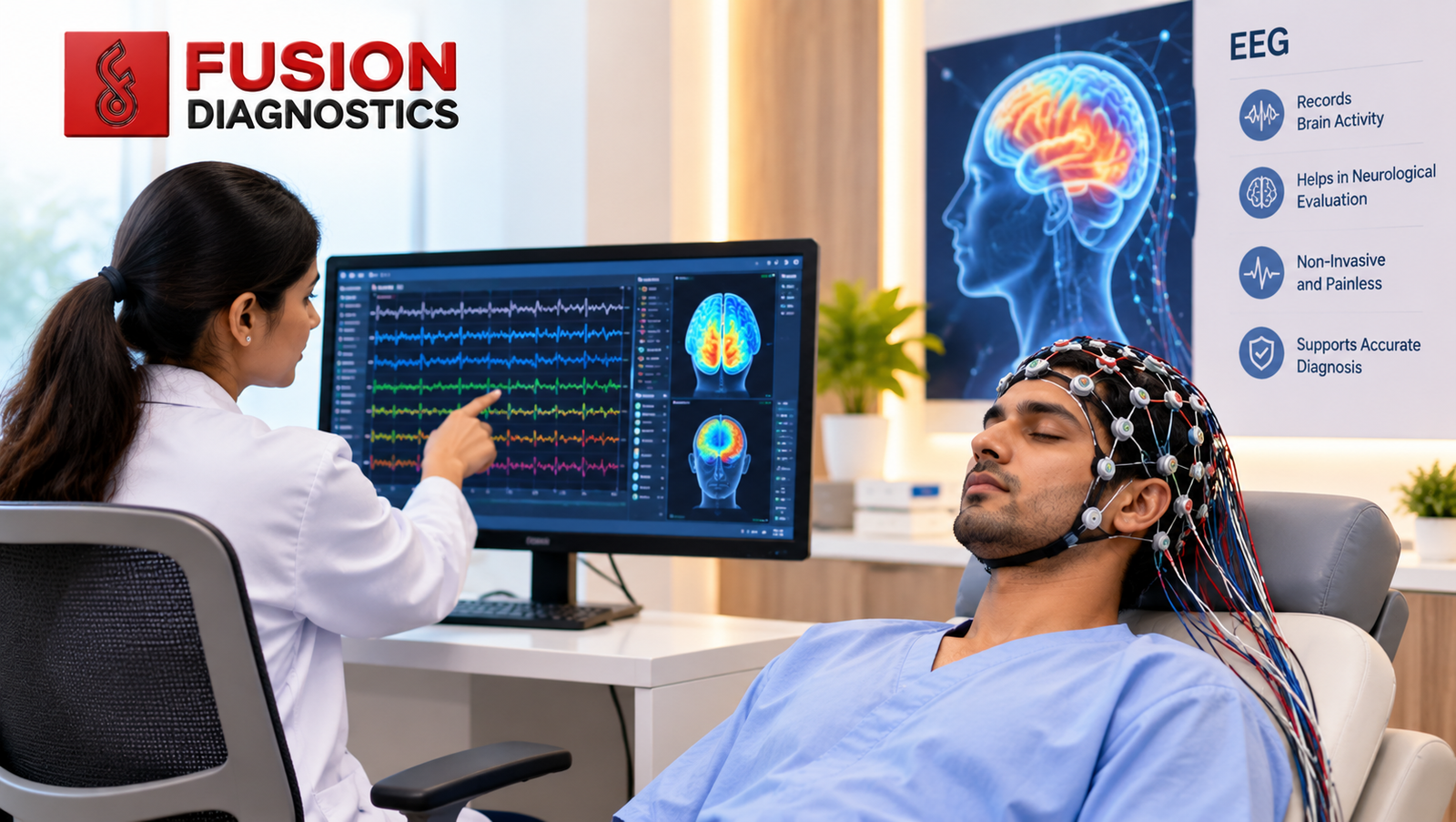
An electroencephalogram is a diagnostic procedure used to record the electrical activity produced by nerve cells in the brain. These signals are detected by electrodes placed on the scalp and displayed as wave patterns on a computer or recording system.

Doctors use EEG recordings to assess patterns of brain activity that may be associated with certain neurological conditions. The test is particularly important in the evaluation of epilepsy and seizures, although it can also be used in selected sleep-related and other neurological assessments.

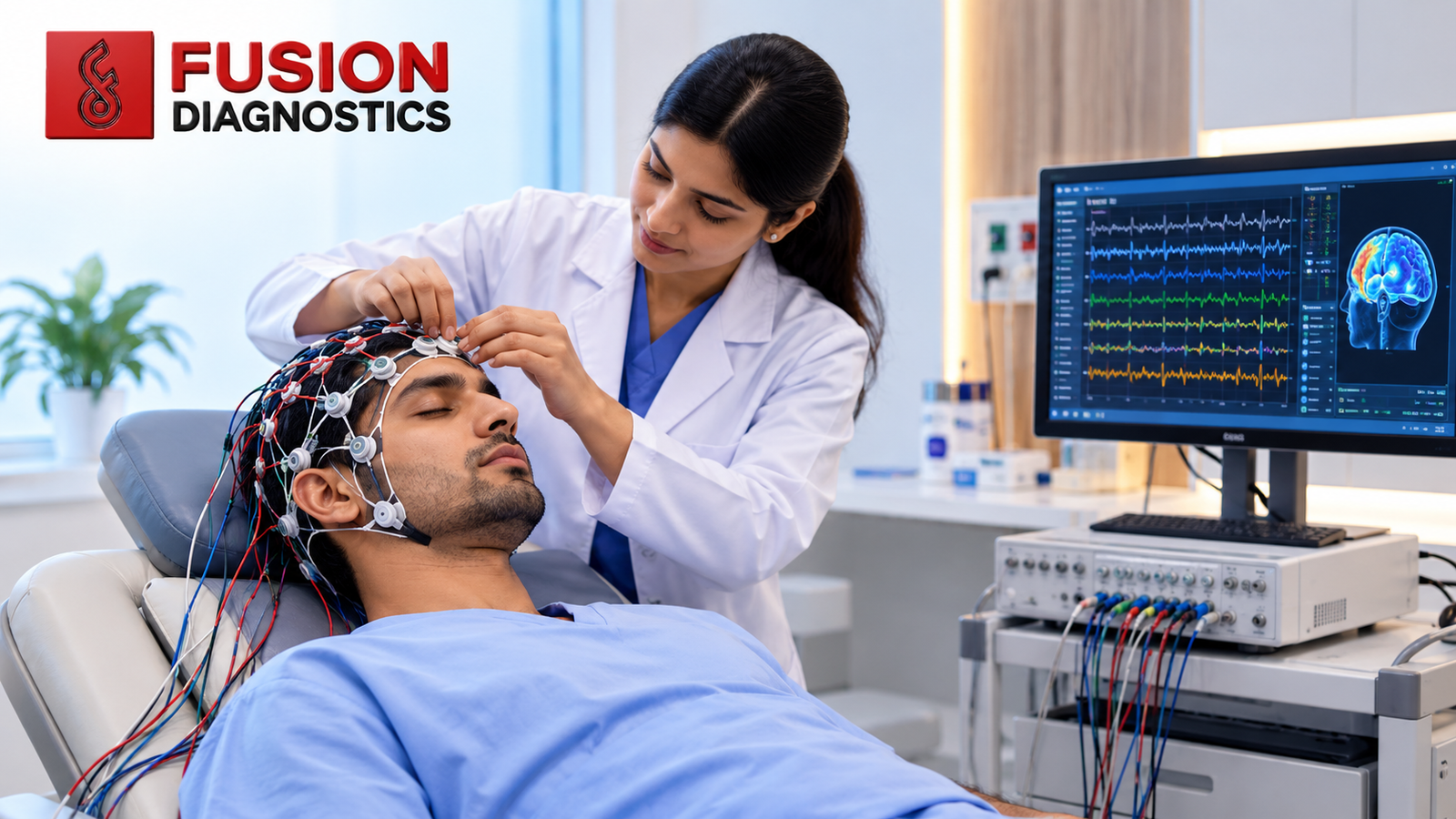
During a routine EEG, a technologist attaches small electrodes to specific positions on the scalp using a suitable conductive paste or electrode system. The recording equipment captures the signals while the patient sits or lies comfortably.

Depending on the clinical requirement, the patient may be asked to open or close their eyes, breathe deeply for a short period or look at a flashing light. Some examinations may also involve recording during sleep.

If your doctor has recommended an EEG in Noida, the appropriate type of recording will depend on your symptoms and the clinical question being investigated.

An EEG does not produce pictures of the brain’s physical structure. It records electrical activity, so it provides different information from imaging tests such as MRI or CT scans.

Why Might a Doctor Recommend an EEG Test?

An EEG may be advised when a doctor needs information about brain-wave patterns or wants to investigate symptoms that could be related to abnormal electrical activity.

Common reasons include:

Seizures

To help evaluate episodes involving involuntary movements, unusual sensations or changes in awareness.

Suspected epilepsy

To look for electrical patterns that may support the diagnosis and classification of certain seizure disorders.

Unexplained episodes

To investigate selected episodes of confusion, staring or loss of awareness.

Sleep-related concerns

Certain EEG recordings may help assess brain activity during sleep when clinically indicated.

Monitoring a known neurological condition

Repeat recordings may be recommended in selected circumstances to help guide clinical assessment.

Specialist neurological evaluation

An EEG may form part of a broader investigation when a neurologist considers it appropriate.

The reason for testing varies from patient to patient. A doctor may recommend additional investigations depending on the symptoms, examination findings and medical history.

EEG Services in Noida at Fusion Diagnostics

Fusion Diagnostics is located at Spectrum Metro Mall, Sector 75, Noida. Patients can contact the centre to enquire about EEG availability and the arrangements required for their prescribed examination.

An electroencephalogram may support the following areas of neurological assessment:

Brain-Wave Recording

An EEG records electrical patterns generated by brain activity. The recording helps a qualified professional assess whether the observed patterns are appropriate for the clinical context.

Seizure and Epilepsy Evaluation

EEG findings can help support the evaluation of certain seizure disorders. The recording may help identify epileptiform activity, although not every person with epilepsy will have an abnormal routine EEG.

Assessment of Episodes of Altered Awareness

When a patient experiences unexplained episodes of staring, confusion or changes in awareness, an EEG may be recommended as part of the diagnostic process.

Sleep-Related Brain Activity

Some EEG studies include sleep recording or are performed under specific sleep-related instructions. The type of test depends on the doctor's recommendation.

Follow-Up Assessment

In selected situations, a doctor may request another EEG to compare recordings or obtain additional information about a neurological condition.

The suitability of each examination depends on clinical requirements. Please confirm the availability of your prescribed EEG study with the centre before visiting.

What Can an EEG Help Detect??

An EEG provides information about the brain’s electrical activity. Its findings may help doctors evaluate certain conditions, but an EEG alone cannot confirm or exclude every neurological disorder.

Epilepsy and Seizure Disorders

An EEG may identify electrical patterns associated with an increased tendency for seizures. It can help a specialist assess the type of electrical activity present and may support decisions about further testing or treatment.

However, a routine EEG can be normal even in someone who has epilepsy. The diagnosis depends on the full clinical picture, including the patient’s symptoms and history.

Unexplained Changes in Awareness

Episodes such as brief periods of unresponsiveness, unusual movements or confusion may have different causes. When a seizure is suspected, an EEG may provide useful information to help a doctor investigate the episodes.

Sleep-Related Conditions

Certain sleep-related investigations use EEG recordings to evaluate brain activity during sleep. Depending on the suspected condition, the doctor may recommend a specific sleep study rather than a routine EEG.

Changes in Brain Electrical Activity

An EEG may reveal patterns that require further assessment. The meaning of a finding depends on the patient’s age, symptoms, medications, state of alertness and other clinical factors.

An abnormal result does not automatically establish a particular diagnosis. Similarly, a normal result does not rule out every neurological condition. Your doctor will interpret the report in context and decide whether additional investigations are needed.

Types Of EEG Test

The type of EEG selected depends on the symptoms and the information required by the treating doctor.

Routine EEG

A standard recording of brain electrical activity, usually performed while the patient is awake. It may include simple tasks such as opening and closing the eyes.

Sleep EEG

A recording that includes sleep or drowsiness when this is considered useful for the clinical evaluation.

Sleep-Deprived EEG

A test performed after following specific sleep instructions provided by the healthcare team. Sleep deprivation may help reveal certain abnormalities that are not seen during a routine recording.

Ambulatory EEG

A longer recording using a portable system that allows brain activity to be monitored over an extended period, sometimes during everyday activities.

Not every diagnostic centre offers every type of EEG. Contact Fusion Diagnostics to confirm which examination is available and whether it matches your doctor’s prescription.

What Is the Difference Between an EEG & MRI Brain?

EEG and MRI brain tests are different investigations. They answer different clinical questions and may sometimes be recommended together.

EEG: Records the brain’s electrical activity. It may help assess seizure-related electrical patterns and certain other neurological concerns.

MRI Brain: Uses a magnetic field and radio waves to create detailed images of brain structures. It may help identify structural changes that require medical evaluation.

An EEG does not provide detailed structural images, and an MRI does not replace EEG when electrical activity needs to be recorded. Your doctor will select the appropriate investigation based on your symptoms and examination findings.

How to Prepare for an EEG Test?

Preparation can affect the quality of an EEG recording. Follow the instructions given by your doctor and the diagnostic team, as requirements may differ according to the type of study.

Before your appointment:

  1. Wash your hair: Keep your hair clean and dry before the examination.
  2. Avoid hair products: Do not apply hair oil, gel, spray or conditioner unless the centre provides different instructions. These products may interfere with electrode contact.
  3. Share your medication list: Tell the healthcare professional about all prescribed medicines and supplements you take.
  4. Follow sleep instructions: If a sleep-deprived EEG has been requested, follow the specific instructions given by your doctor or the centre.
  5. Ask about food and drinks: Fasting is generally not required for a routine EEG, but follow any individual instructions provided for your examination.
  6. Bring previous reports: Carry earlier EEG reports and relevant medical records if available.
  7. Arrange assistance if needed: If your test involves sleep deprivation or you have a history of seizures, ask your doctor whether you should travel with someone.
EEG in Noida
EEG Monitoring in Fusion Diagnostics

Do not stop anti-seizure medicines or any other prescribed medication unless your treating doctor specifically instructs you to do so.

What Happens During an EEG?

A routine EEG is usually performed while the patient sits in a comfortable chair or lies on an examination bed.

Step 1: Initial preparation

The technologist explains the procedure and prepares the scalp. Measurements may be taken to identify the correct electrode positions.

Step 2: Electrode placement

Small electrodes are attached to selected areas of the scalp using a conductive paste or an appropriate electrode system. The electrodes connect to the recording equipment through wires or a compatible cap.

Step 3: Recording brain activity

The equipment records electrical signals and displays them as wave patterns. You will usually be asked to remain relaxed and still during the recording.

Step 4: Following instructions

Depending on the test, you may be asked to open or close your eyes, breathe deeply for a short time or look at a flashing light. These steps are performed only when appropriate for the individual examination.

Step 5: Completion

After the recording, the electrodes are removed and any remaining paste can be cleaned from the hair. You can generally resume normal activities after a routine EEG unless your doctor provides different instructions.

The length of the examination depends on the type of recording and the clinical requirements. Sleep studies and extended recordings may take longer than a routine EEG.

Is an EEG Safe and Painless?

An EEG is generally considered a safe, non-invasive test. The electrodes record electrical activity produced naturally by the brain; they do not deliver electrical current into the brain.

The procedure is usually painless. Some patients may experience mild scalp discomfort when the electrodes or paste are removed. If deep breathing or flashing-light stimulation is included, temporary light-headedness or discomfort can occur.

In selected patients, stimulation procedures may provoke symptoms or a seizure. The healthcare team determines whether these steps are appropriate and monitors the patient during the recording.

Inform the team about your medical history, recent seizures, sensitivity to flashing lights and any concerns before the examination. Follow the preparation instructions provided for your specific test.

Understanding Your EEG Report

An EEG report describes the electrical patterns observed during the recording. It may include information about background activity, changes seen during the test and any patterns that require clinical correlation.

A specialist interprets the recording in the context of the patient’s age, symptoms, medical history and medication use.

Some important points to understand:

  • Normal EEG: A normal routine recording does not exclude epilepsy or every other neurological condition.
  • Abnormal patterns: Certain findings may support a diagnosis, but they must be interpreted in context.
  • Clinical correlation: The doctor considers the EEG alongside the history of symptoms and other test results.
  • Further evaluation: If symptoms continue despite a normal result, additional testing or a longer recording may be recommended.

Do not make changes to medication or treatment based only on the wording of an EEG report. Discuss the findings with the doctor who requested the examination.

Frequently Asked Questions About an EEG in Noida

You can contact Fusion Diagnostics at Spectrum Metro Mall, Sector 75, Noida, to enquire about EEG availability, appointment scheduling and preparation instructions.

An EEG records electrical activity in the brain. It is commonly used to support the evaluation of epilepsy, seizures and selected neurological or sleep-related conditions.

No. A routine EEG is generally painless. Small electrodes are placed on the scalp to record brain-wave patterns.

The duration depends on the type of examination. A routine EEG often takes around 20–60 minutes, while sleep or extended recordings may take longer. Confirm the expected duration for your prescribed test.

Yes, clean, dry hair is generally recommended. Avoid hair oil, gel, spray and other styling products so the electrodes can make good contact with the scalp.

An EEG can provide findings that support the evaluation of epilepsy, but it is not sufficient on its own in every case. Diagnosis depends on symptoms, medical history and clinical assessment.

Yes. Some people with epilepsy have a normal routine EEG because abnormal electrical activity may not occur during the recording. A doctor may recommend further monitoring if clinically necessary.

EEG is commonly used in children when a doctor considers it appropriate. Preparation and instructions may differ according to the child’s age and the type of test.

Do not stop or change prescribed medicines unless your treating doctor specifically instructs you to do so. Tell the healthcare team which medicines you take.

Call Fusion Diagnostics at +91 92 88 22 77 44 to enquire about the availability of your prescribed test, appointment arrangements and preparation requirements.

EEG IN NOIDA

Contact Fusion Diagnostics for an EEG in Noida?

Get in touch with Fusion Diagnostics Noida to schedule your EEG appointment or discuss the examination recommended by your doctor.

Fusion Diagnostics Noida
Phase 2, Spectrum Metro Mall, Lower Ground Floor, Tower A, Gardenia Gateway, Sector 75, Noida – 201316
Book Your EEG Test Appointment
+91 92 88 22 77 44